
Connected bandage for monitoring healing
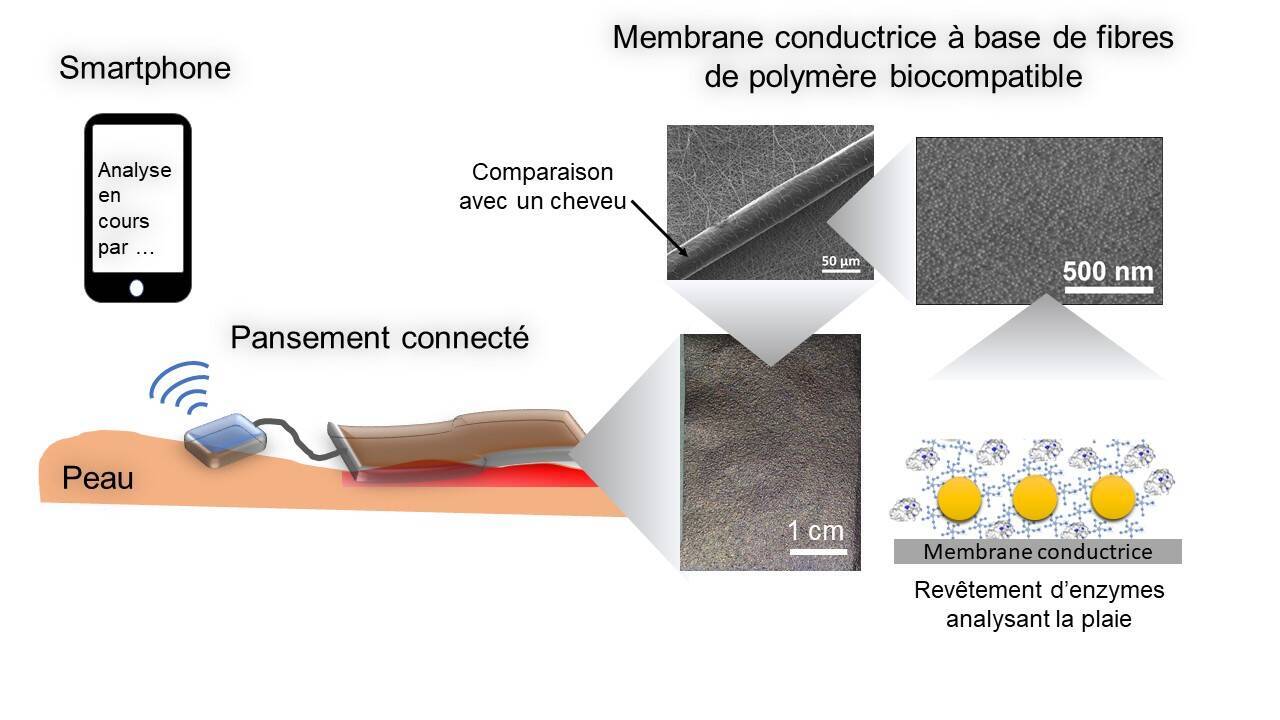
Imagining the first mechanisms and developments for the creation of a connected bandage is the core objective of the Biosensdress project, funded by Carnot MICA, which has just been completed. These advances could revolutionize the care of patients with severe wounds requiring long-term monitoring, such as those of major burn victims. The idea is to accurately monitor wound healing while limiting the need to frequently change dressings.
Combining two strong areas of expertise
In 2019, Anne Hébraud and Fouzia Boulmedais, researchers at ICPEES* and ICS*, had the idea to combine their expertise, respectively in the design of nanofibrous membranes by electrospinning based on biocompatible and/or biodegradable polymers and in the development of electrochemical biosensors. The goal: to create a “connected” bandage that would interact with the evolving biological environment of the wound and provide real-time information on its proper healing.
On the ICPEES side, the electrospinning technology used to create nanofibrous membranes is particularly interesting, as it enables the production of dressings with fibers ranging from tens to hundreds of nanometers in diameter and pores smaller than one micrometer. This provides an excellent barrier against microorganisms while allowing gas exchange so the wound can breathe.
On the ICS side, strong expertise in electrochemical biosensor development is leveraged to give the bandage its expected function: monitoring the evolution of the wound’s condition under the dressing through the analysis and quantification of targeted molecules.
The importance of glucose and pH
In this project, the researchers focused on the measurement of glucose and pH. Glucose is a metabolite closely monitored in diabetic patients. It turns out that glucose levels in a wound play an important role in its healing. Indeed, low glucose levels are a sign of a wound that is struggling to heal. In addition, monitoring pH also helps track the healing process. Once the target molecule was identified, Fouzia Boulmedais’ team successfully developed a biosensor composed of gold nanoparticles crosslinked at the surface to immobilize an enzyme, glucose oxidase, which has the ability to interact with glucose. This enzymatic sensor thus enables the measurement of glucose levels in the wound.
The next step was to develop a biocompatible and flexible electrical circuit capable of transporting the electrons produced by the interaction between glucose oxidase and glucose. These electrons collected by the circuit make it possible to measure the glucose level in the wound. To achieve this, Anne Hébraud’s team had the idea of coating polyurethane nanofibrous membranes with graphene sheets. These carbon-based materials make the membrane fibers conductive.
*Institute of Chemistry and Processes for Energy, Environment and Health: ICPEES
*Charles Sadron Institute: ICS