
A Test Bench for High-Pressure Hydrogen Tanks
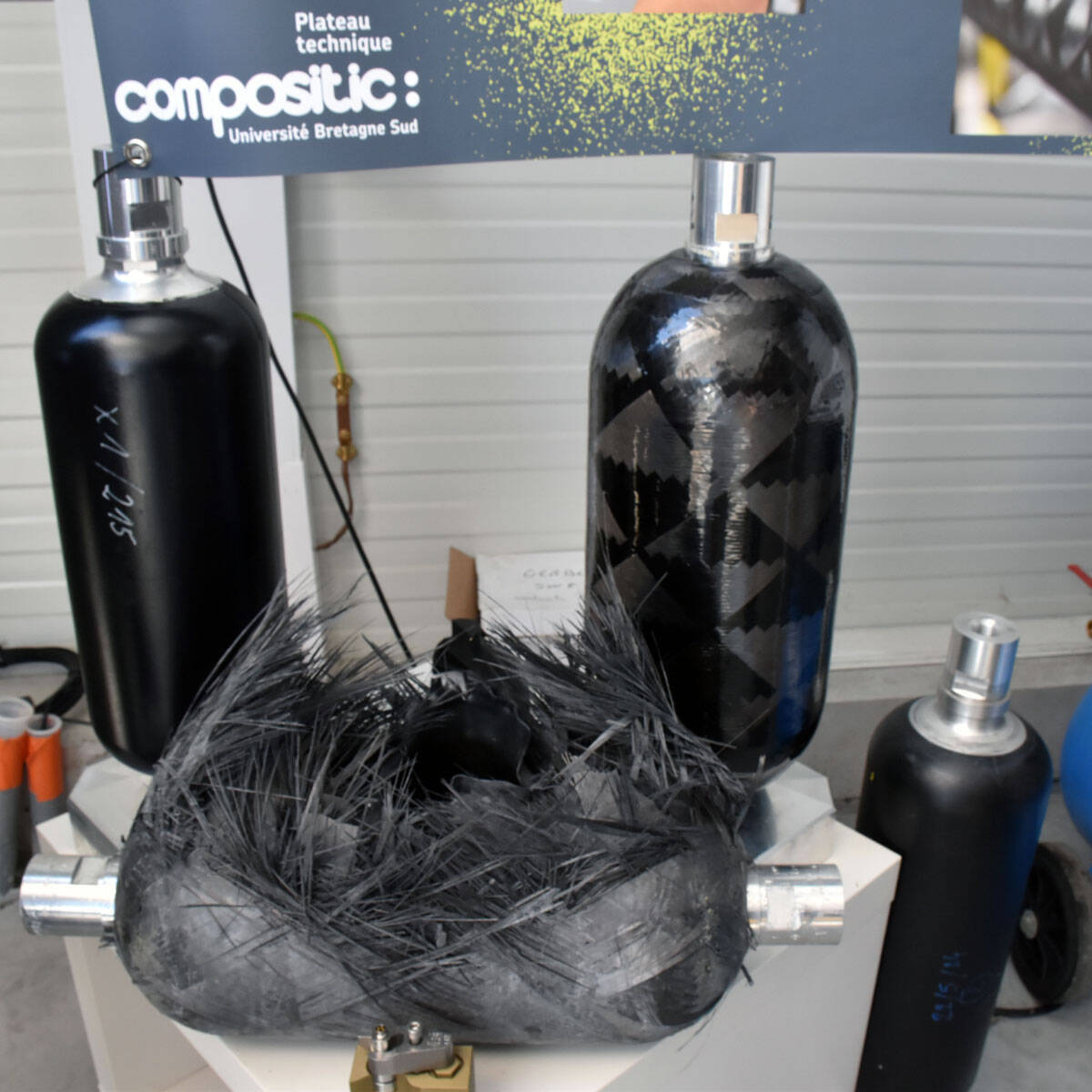
UBSIDE operates a new high-pressure hydrogen tank test bench — unique in France
Press Release – Mulhouse, September 17, 2024
A member of Carnot MICA, UBSIDE has been developing expertise for several years that enables designers and manufacturers of high-pressure tanks (including hydrogen tanks) to accelerate their R&D activities. To achieve this, UBSIDE relies both on its in-house capabilities and on the technological building blocks and experts from the ComposiTIC technical platform (Ploemeur, Morbihan), a Carnot ARTS member of IRDL at the Université Bretagne Sud (UBS).
Through this combination of skills, UBSIDE currently offers services in design sizing, filament winding and AFP lay-up, recycling, and thermomechanical evaluation of specimens and tanks.
To further expand its offering, UBSIDE now operates, as a service provider, UBS’s latest investment: a test bench designed to perform burst tests on high-pressure tanks, including Type IV hydrogen tanks. Equipped with sensors and acoustic cameras, this test bench — unique in France — enables tanks to be tested under pressure up to failure. The objective is to understand burst mechanisms and identify improvement pathways.
This burst and cycling test bench responds to strong demand from the automotive, aerospace, and freight transport sectors, where hydrogen mobility and energy transition challenges are considerable.
The new equipment was co-funded (€600,000) by the Université Bretagne Sud, the Brittany Region, and Lorient Agglomération, with additional support from the European FEDER fund.
Inauguration of the hydrogen tank test bench
Removing Barriers to hydrogen
According to the hydrogen deployment strategy for the energy transition, the development of clean mobility is one of the primary objectives. In France, by 2030, the Vig’hy Hydrogen Observatory forecasts an industrial demand of 295,000 tonnes (30% of the market) and mobility demand of 342,000 tonnes (150,000 light vehicles and 9,000 heavy vehicles). This represents a major mobility challenge, as hydrogen offers a promising alternative to reduce greenhouse gas emissions.
However, since hydrogen is not a primary energy source, it must first be produced and stored. In automotive applications, hydrogen is stored onboard in compressed form. Yet tank weight, size, and cost remain limiting factors for suppliers. A typical vehicle requires approximately 2.25 tanks of 62 liters each to ensure sufficient driving range. With each tank weighing between 30 and 45 kg and operating at pressures up to 700 bar, the automotive and logistics industries face significant challenges for large-scale deployment.
Additional challenges include process control and adapting tanks for small- and medium-series applications (trucks, forklifts, ships, etc.). These competencies are also relevant to pressurized gas containers beyond hydrogen, as well as composite vacuum containers used in deep-sea environments.
For the past four years, UBSIDE has been working to improve understanding of materials and manufacturing technologies to optimize current Type IV tanks. Together with ComposiTIC, UBSIDE is also developing concepts for innovative next-generation tanks (recyclable, conformable thermoplastics).
UBSIDE’s mission is to help manufacturers identify new composite materials, test their properties (strength, adhesion, compatibility with automated machinery), and develop new processes — particularly for thermoplastic composites — to achieve optimal performance through the best material-process combinations. UBSIDE also supports material suppliers dedicated to pressure vessel applications by evaluating the potential of their composite solutions.
A Unique Test Bench to Understand Burst Phenomena
Located at UBS facilities in Lorient, this test bench, operated jointly by ComposiTIC and UBSIDE, is used to evaluate hydrogen tank resistance through repeated pressurization (cycling) and to determine burst pressure.
The installation can test tanks up to 1,600 mm in length, with a maximum internal hydraulic pressure of 2,000 bar, while measuring deformation during pressurization.
Unique in France, the bench distinguishes itself through its advanced measurement capabilities. Thanks to 120 acoustic sensors distributed across the chamber and high-resolution digital image correlation cameras, damage localization can now be determined with high precision.
ages numériques à haute résolution, il est désormais possible de déterminer avec précision la localisation des endommagements.
Frédéric FOURREAU, CEO of UBSIDE: “Understanding the causes of hydrogen tank failure is essential to identify improvement opportunities. This new test bench allows us to push our investigations further and establish advanced composite characterizations. It enables us to assess material quality and propose solutions — whether materials or processes — to reinforce tank structures. In other words, we help our clients understand what happens inside their tanks. We are their R&D support partner and provider of innovative ideas. At the same time, we are developing modeling tools for tank sizing and optimization. Our goal is to place the right amount of composite material in the right location, reducing material costs, tank weight, product costs, and environmental impact.”
Synergies Between Industry and Academia
To acquire this test bench, the Université Bretagne Sud acted as a catalyst hub, identifying companies across plastics, metallurgy, and composites sectors requiring such equipment. Interest from ten stakeholders enabled the development of a funding proposal.
The Brittany Region, UBS, and Lorient Agglomération invested €350,000 for the equipment purchase. UBS funded installation, safety measures, complementary investments, and facility upgrades (€250,000), bringing the total investment close to €600,000.
Yves GROHENS, Director of ComposiTIC, Université Bretagne Sud:
“This equipment reflects the excellent synergies and complementarities among all project partners. Each contributed expertise and activated networks to assess industrial interest. UBS not only supported the investment but also performs testing on final tanks. ComposiTIC has been engaged in Type IV hydrogen tank development from early validation phases through burst and cycling tests.”
Carnot MICA has supported UBSIDE’s development since 2020, particularly in strengthening relationships with major industrial players.
Christian Gauthier, Director of Carnot MICA:
“Demand related to hydrogen storage and transport is increasing, as is the need for materials enabling hydrogen production and transfer. Several Carnot MICA members are working on polymer and composite behavior at very low temperatures, metallic materials, and advanced alloys. The growing expertise of Carnot MICA members in hydrogen technologies is a key asset for supporting manufacturers across the entire value chain.”
Christian Gauthier, Director of Carnot MICA: “Demand related to hydrogen storage and transport is increasing, as is the need for materials enabling hydrogen production and transfer. Several Carnot MICA members are working on polymer and composite behavior at very low temperatures, metallic materials, and advanced alloys. The growing expertise of Carnot MICA members in hydrogen technologies is a key asset for supporting manufacturers across the entire value chain.”
About Carnot MICA
Specializing in functional materials, surfaces, interfaces, and related processes, Carnot MICA supports manufacturers in developing products and services. With more than 900 industrial partners, MICA delivers tailored R&D programs, services, and expertise. Carnot MICA brings together 18 research and technology organizations in France’s Grand Est region, offering capabilities from fundamental research to industrial applications.
About UBSIDE
Founded in 1990, UBSIDE is a technical center operating at the interface between research and industry. It develops innovative technologies in advanced materials, including structural composites and low-environmental-impact polymers. UBSIDE conducts experiments, develops processes, produces prototypes, characterizes materials, and advises member companies. The association also participates in collaborative national and European research projects.
About ComposiTIC
For over ten years, the ComposiTIC technical platform at Université Bretagne Sud (Carnot ARTS member) has focused on R&D, technology transfer, and training. It supports SMEs in transitioning from traditional composite manufacturing to automated and robotic technologies, while addressing economic, environmental, and social impacts. ComposiTIC’s forward-looking projects notably include hydrogen storage systems and composite recyclability.
CONTACT PRESSE | Agence OXYGEN
Elise CORDIER – elisec@oxygen-rp.com – 03 67 22 03 25