
From 3D microstructures to “living” surface properties
From 3D Microstructures to “Living” Surface Properties
Tissue engineering, microrobotics, photonics… these are just some of the fields where micro 3D printing opens up major possibilities. However, objects produced using this process often have surface properties that are difficult to tune. Researchers from IS2M (CNRS / University of Haute-Alsace) have developed a strategy based on controlled radical polymerization to modify, in a simple and precise way using light, the surface properties of 3D micro-objects.
These results were recently published in Advanced Functional Materials.
A strategy for post-functionalization of micro-objects
Micro 3D printing by photopolymerization has grown significantly in recent years thanks to increasingly advanced high-precision printers. These tools enable rapid prototyping of complex 3D structures from the nanoscale to the millimeter scale. However, despite these technological advances, the surface properties of micro-objects remain difficult to modify, as they are determined by the polymer resin used during fabrication.
Yet, the ability to decorate micro-object surfaces with nanometric patterns or to guide cell adhesion only in specific areas is highly desirable. This challenge is now addressed through a new post-functionalization strategy developed by IS2M researchers, who used macromolecular photo-initiators synthesized via controlled radical polymerization.
A new approach: “living” polymers
Unlike conventional photopolymerization, where polymer chains are “dead” once formed, the researchers used so-called “living” polymer chains. These remain reactive and can re-initiate photopolymerization reactions directly from the surface of the object.
This approach allows the successive addition of different monomers with distinct properties, such as:
- Cell adhesion or anti-adhesion
- Hydrophilic or hydrophobic behavior
- Rigidity or flexibility
- Electrical or thermal conductivity or insulation
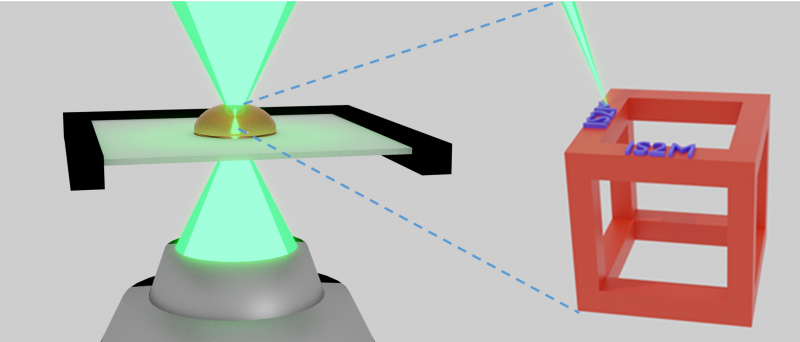
Using a focused light source also makes it possible to precisely localize these modifications on the surface of the object.
Toward 4D functional microstructures
By combining micro 3D printing and macromolecular engineering, this method enables unprecedented spatio-temporal control over chemical and physicochemical surface modifications. As a result, the fabricated objects can exhibit “4D” behavior, with properties that evolve in space and time.
On-demand Editing of Surface Properties of Microstructures Made By 3D Direct Laser Writing via Photo-mediated RAFT polymerization
On-demand Editing of Surface Properties of Microstructures Made by 3D Direct Laser Writing via Photo-mediated RAFT polymerization
Xingyu Wu et al., Advanced Functional Materials, 2021
DOI: 10.1002/adfm.202109446