Revolutionising plastic food packaging recycling
In the ongoing search for environmental solutions, the Variform project emerges as a promising response. The European Union aims to achieve 100% plastic recycling by 2025. This inter-Carnot project is funded by Carnot MICA and Carnot Ingénierie at Lyon. It is led by the Charles Sadron Institute (ICS) and the Technical Industrial Centre for Plastics and Composites (IPC). It is part of a research programme dedicated to the valorisation of plastic waste through multiphase blend recycling.
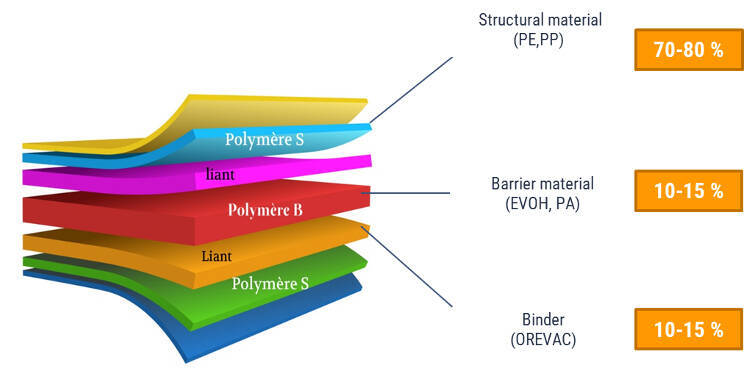
Flexible plastic food packaging is widely used to improve the preservation of perishable foods. It is designed by layering different polymer materials, each serving a specific function. These layers are bonded together using copolymer-based adhesives. These multilayer materials consist of a mixture of incompatible polymers due to their very different viscosities and variable composition over time. This makes them extremely difficult to recycle at end of life. As a result, 75% of this waste is incinerated or landfilled.
In this context, researchers from the Variform project have developed an innovative concept enabling the in-situ creation of tailor-made compatibilising agents for recycling plastic waste from flexible food packaging.
Modifying recycling processes to make plastics compatible
This concept, known as Mechanochemical Recycling (MCR), combines the principles of conventional mechanical recycling and chemical recycling. It is based on the introduction of chemical precursors into polymer blends in the molten state, enabling the in-situ synthesis during processing time of block copolymers from the different macromolecular chains present. These chemical structures are well known to localise at interfaces in heterophase blends, stabilising them.
In the case of flexible food packaging, adhesives have been used as precursors to develop stabilised alloys that can be reused for other applications. This new technology also offers the advantage of minimising material and energy costs, without requiring prior knowledge of the chemical composition of the polymer mixture.
Early trials conducted on a demonstrator successfully validated this strategy on model blends. The next step will be to extend the method to real waste streams, while assessing property variations depending on supply sources.
The Variform project stands as a major advancement in the fight against plastic pollution, offering a tangible solution to transform food packaging waste into new resources and contribute to a more sustainable and environmentally friendly future.
Want to learn more? Watch the explanatory video of this project ➡️ https://www.youtube.com/watch?v=Z48DtgodYII