
UV jet printing
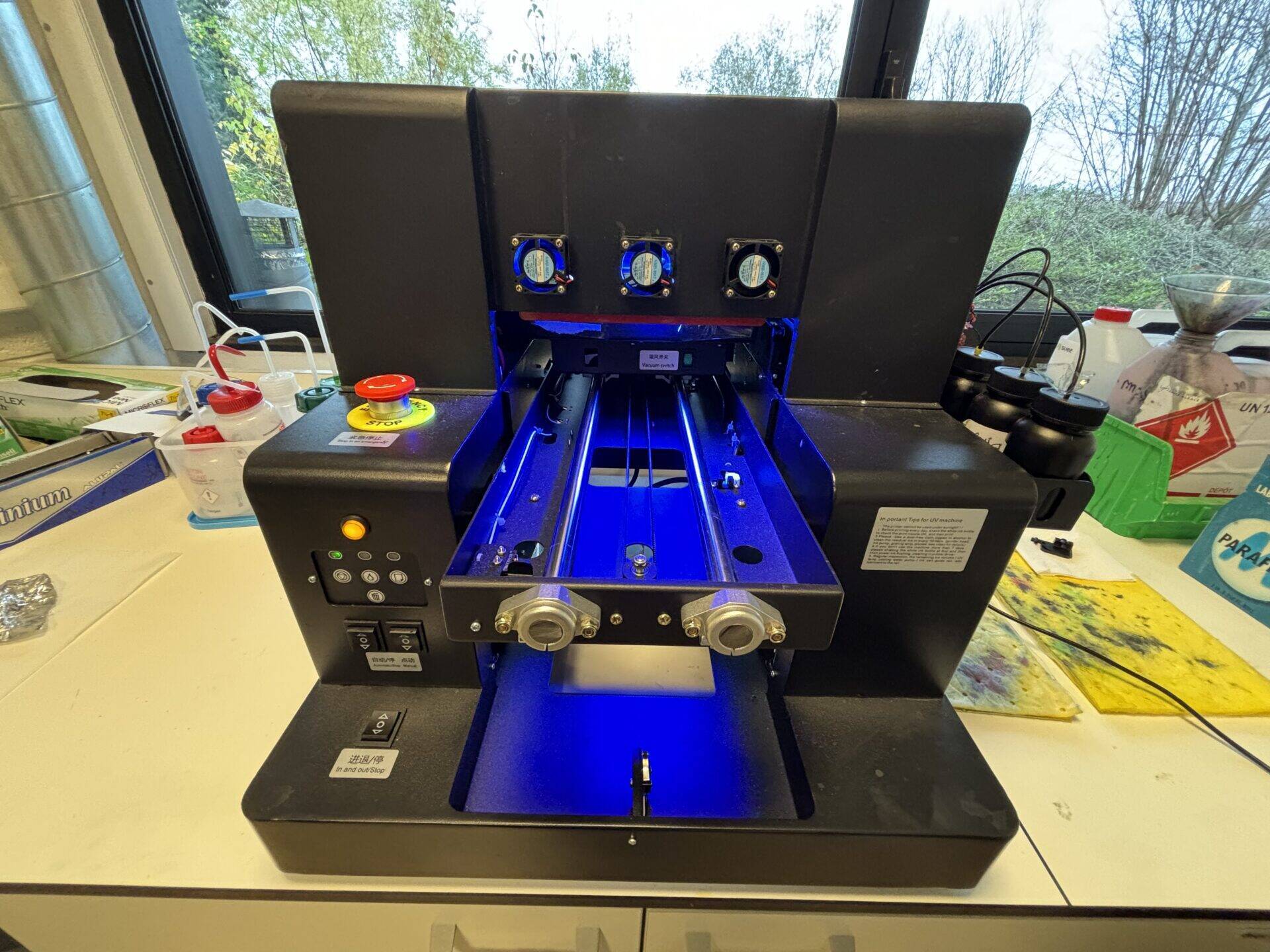
A high-performance direct deposition technology
UV Jet printing is now one of the most efficient technologies for direct material deposition on objects. Presented by Jacques Lalevée, Associate Professor at IS2M, and Rafael Assis, PhD student in the same laboratory (a member of the Carnot MICA), this technique combines precision, high speed and instant polymerization using a UV lamp. For industrial players, it offers strong potential to optimize processes, reduce energy consumption and improve final rendering across a wide range of substrates.
UV Jet: mechanism, industrial gains and key advantages
UV Jet printing relies on the controlled projection of ink droplets directly onto the object, followed by immediate curing using UV light. This combination enables extremely precise deposition control and ensures high spatial and graphical resolution. The operational benefits are numerous:
- significant efficiency gains,
- reduced energy consumption,
- precise and repeatable material deposition,
- a digital workflow enabling direct transfer of data to the substrate.
Industrial applications and material challenges in UV Jet printing
Applications of this technology span multiple sectors. In graphic arts, it is a preferred solution for high-resolution digital printing. In automotive and aerospace industries, it is increasingly replacing traditional painting processes to reduce material waste and improve production efficiency. More recently, 3D printing has adopted this technology to deposit material layer by layer, enabling the fabrication of multi-material objects such as electronic components (conductive and insulating layers), composites, and technical parts for the medical field.
A major research challenge concerns black inks, which are known to be the most difficult to polymerize: their pigment strongly absorbs light, reducing the efficiency of the photoinitiator system. In Rafael Assis’s PhD work, this challenge was deliberately addressed: successfully polymerizing black ink paves the way for strong performance across other colors. The ultimate objective is to achieve optimized surface rendering to simulate paint on various substrates, a key issue for finishing and surface treatment industries.
This technology is now one of the essential digital processes, particularly in industrial environments aiming to control consumption and reduce waste.