
Laser innovation in polymer durability
Laser innovation in polymer durability
The global crisis caused by the Covid-19 pandemic highlighted the omnipresence of plastics in everyday life, particularly through the massive use of surgical masks, single-use products, and sterile packaging. However, conventional plastics raise major environmental concerns due to their poor recyclability and difficult degradation. A promising alternative lies in the use of bio-based and biodegradable polymers modified by laser treatment.
It is in this context that the BIPOLAIR project, funded by Carnot MICA, was launched. This initiative is the result of a collaboration between research engineering teams from UBSIDE (1) and IREPA LASER. Its objective is to explore the potential of laser technology to impart controlled ageing behavior and mechanical resistance to biodegradable polymers.
Laser processing of polymers: toward precise control of degradation and mechanical performance
Unlike conventional methods that modify polymer properties through chemical additives, laser treatment acts directly on the material surface. Researchers investigate the effects of localized texturing and controlled heating on key parameters such as crystallinity, surface roughness, and phase transitions within the material. The goal is to better control degradation kinetics while preserving mechanical strength.
After one year of research, results obtained after marine ageing and analyzed using scanning electron microscopy (SEM) are promising. In some cases, an acceleration of the degradation kinetics of PHA films was observed, along with increased surface roughness and irregularities—effects not seen in untreated PHA films. This demonstrates that ageing can be accelerated even under natural conditions.
However, slowing down degradation remains more challenging. Results show little influence from treatments aimed at reducing degradation compared to untreated films.
Toward biomimetic and advanced control strategies
Researchers aim to further deepen the understanding of laser–polymer interactions, particularly by studying the thermal properties of treated samples. Improvement pathways, especially inspired by biomimicry, could provide innovative ways to better control degradation kinetics.
Some laser techniques are even capable of reproducing textures inspired by animal or plant surfaces, known for their hydrophobic properties, opening the door to new functional and environmentally adaptive materials.
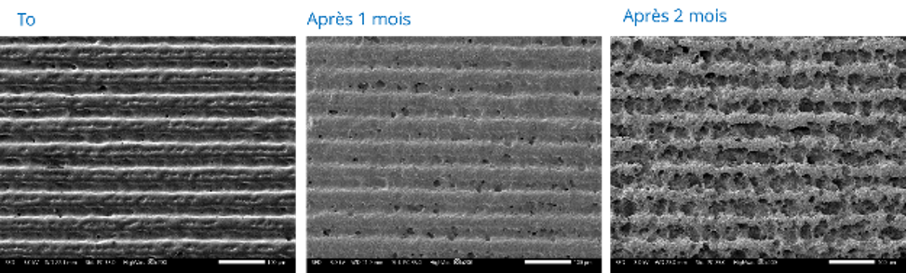
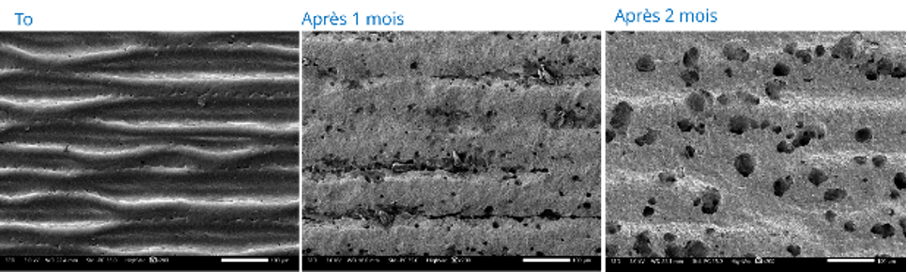
Figure 2: Microscopic observations of the PHA film with laser treatment FS_40 before and after 1 and 2 months of marine immersion (×200 magnification) – ©UBSIDE
(1) Resulting from the restructuring of the activities of the Regional Institute for Advanced Materials (IRMA), UBSIDE offers a range of services designed based on field needs, in close collaboration with economic stakeholders.