
March 2021: IS2M, a member of Carnot MICA, developed a zeolite pellet for the Perseverance rover
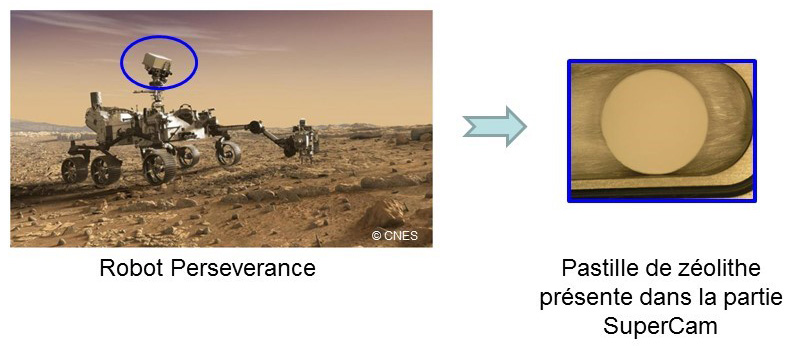
Zeolite Pellet in SuperCam
A zeolite pellet has been integrated into the laser cavity of the SuperCam instrument on the Perseverance rover. Its purpose is to prevent condensation within the camera, enabling the robot to collect sound and light data. This pellet is the result of a collaboration between the French Space Agency (CNES) and the Institute of Materials Science of Mulhouse (IS2M, UMR 7361 CNRS-UHA), a member of Carnot MICA.
The zeolite pellet is designed to trap volatile organic compounds (VOCs) released through outgassing from SuperCam’s components. These emissions occur due to temperature fluctuations on Mars. Another objective is to prevent these compounds from condensing on critical surfaces such as lenses. As a result, the pellet helps maintain the performance and longevity of onboard instruments.
Over recent decades, maintaining the lifespan and performance of space systems has become increasingly critical. The space industry has therefore focused on the issue of molecular contamination in orbit. This contamination can significantly impact the durability of high-tech instruments onboard satellites and robotic systems, including detectors, thermal control coatings, and optical or electronic devices. It is caused by pollutant molecules known as volatile organic compounds (VOCs), which are released under vacuum from materials such as lubricants, paints, varnishes, and adhesives, and then deposit on sensitive surfaces.
“Molecular contamination resulting from outgassing under vacuum has a significant impact on the lifespan of high-tech instruments onboard satellites and robotic systems.”
To address this challenge, a collaboration began in 2001. The work carried out by CNES and the MPC (Controlled Porosity Materials) research group at IS2M led to four completed PhD theses.
Initial research demonstrated the high performance of zeolites, which exhibit excellent adsorption and retention capabilities for VOCs. However, using zeolites in powder form would introduce a new source of particulate contamination. This led to the need for shaping them into a more suitable form. Researchers including Guillaume Rioland, Jean Daou, Joël Patarin, and Delphine Faye contributed to further studies that resulted in the development of the pellet format, which proved to be the most effective solution.
One of these Mulhouse-designed zeolite pellets was already used in 2011 on the Curiosity rover, also sent to Mars, to trap organic pollutants and reduce molecular contamination in the ChemCam instrument.
A fifth PhD project currently underway* continues this line of research, aiming to develop an optimized zeolite-based coating for molecular decontamination in orbit.
*Co-funded by CNES and the company Zéphir Alsace