
New methods for testing molecules to develop medicines
Optimizing molecular testing protocols
Developing new medicines
The pharmaceutical industry conducts extensive testing when identifying a biomolecule involved in the development of a known disease. The objective is to find a chemical molecule capable of treating or neutralizing it. Among these tests, high-throughput screening consists of studying the interaction between the target biomolecule and millions of chemical compounds listed in a “chemical library.” The goal is to identify candidates for the development of new drugs.
Screening campaigns are carried out at “high throughput,” meaning robots handle dozens of microplates. Each plate contains hundreds of wells holding just a few microliters of solution, combining the biomolecule with a compound from the library. To detect molecular interactions, robots typically measure light emission from each well—known as fluorescence intensity.
A more reliable method
While this technique is widely used and validated in the pharmaceutical industry, researchers at IPCMS, a member of Carnot MICA, have developed a more reliable alternative. Instead of measuring fluorescence intensity, they measure the fluorescence lifetime. The key advantage of this approach is that it eliminates uncertainties related to variations in concentration within the solution.
Fluorescence lifetime measurement confirms molecular interaction independently of concentration fluctuations between samples. In contrast, intensity-based measurements can generate many false positives or false negatives when concentrations are poorly controlled—for example in in cellulo experiments. This more reliable method significantly reduces error rates. The benefit: fewer screening cycles, saving time and reducing costs for campaigns that can otherwise last several months.
The prototype
Although the method has proven effective, its industrial deployment in the pharmaceutical sector remains to be completed. The efficiency and sensitivity of fluorescence lifetime measurements are well established, but it must still be demonstrated that data acquisition speed matches that of current, simpler methods.
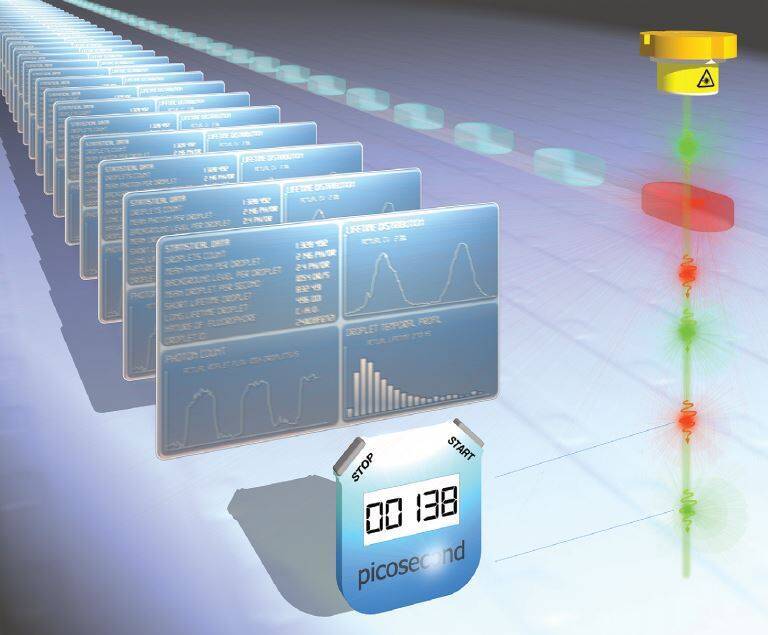
To meet—and even exceed—current screening speeds, IPCMS researchers have developed a prototype combining microfluidics and microelectronics. By using microfluidic chips, they generate microdroplets efficiently. Each droplet acts as a reservoir approximately 10,000 times smaller than a conventional microwell. These droplets can be manipulated at much higher flow rates than traditional microplate systems, making integration into existing testing workflows highly feasible.
The fluorescence lifetime measurement device is fully suitable for industrial integration and production, thanks to advances in microelectronics. It also offers reduced production costs.
Replacing fluorescence intensity measurements with fluorescence lifetime measurements—at very high throughput and with maximum sensitivity—could lead the pharmaceutical industry to develop new biochemical testing protocols. These protocols would enable direct testing of molecular interactions within cells, ultimately supporting the more efficient development of tomorrow’s medicines.